Are Essential Oil Diffusers Safe?
What are their long-term health impacts? What type of diffusers do we recommend?
Scent diffusers have been used commercially in the hospitality industry for a very long time, and as of late it has been popularized travelers using it at home. Travelers often wish to recreate the scent of their favorite hotel at home or in other cases, folks simply like a hint of fragrance throughout their home.
The growth in popularity has spurred a lot of questions on safety and impacts on long-term usage. Bottom line, no study has linked any harmful effects to either humans or pets, and vast majority of people are able to enjoy scenting their homes. However, just as is the case with skin-contact perfumes and fragrances, some users will experience allergic reactions such as headache or skin irritation. In this article, we’ll shed some more light on the topic of types of diffusers, how to use safely and provide our perspective and recommendation.

What is a scent diffuser and how does it work?
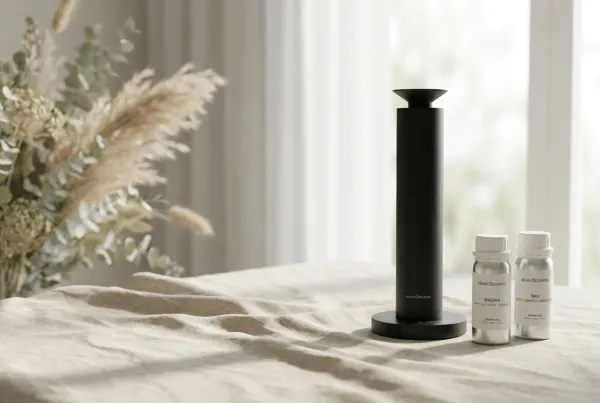
The scent diffuser can be an electronic device, or a reed-based (non-electronic) glass dish used to infuse small quantities of fragrance into a designated area. At its core, it simply serves as a technology to deliver the scent to the desired area.
The diffuser can be a standalone unit, or it can be integrated with the HVAC system, which is normally used for residential homes or larger commercial size properties such as hotel lobbies. The intent of the integrated HVAC diffusers is for controlled delivery in residential use.
There are four main types of diffusers: a pluggable diffuser, a commercial diffuser that uses chemical mixtures (such as the ones used in airport bathrooms), HVAC integrated diffusers that deliver small, controlled amounts of vaporized scent and lastly reed diffusers, which are usually small glass bottles or bowls that hold the scent (in liquid form) with reeds or sticks sticking out of the glass bottle.
There are significant differences between the diffusers, primary being how they deliver the scent, and the ingredients used. Electronic chemical diffuser bursts a larger quantity into the air with one strong mist on timed intervals. The timing and quantity dispersed cannot be controlled, leading to waist and over-scenting of the designated area. In comparison, water and oil-based diffusers gradually releases the scent, where the reed-based diffuser will have a strong scent at the open and gradually diminish in intensity over time.
In terms of safety, no study has indicated any notable difference between them. Diffusers available for purchase in the US retail market have been deemed safe to use for in-home and commercial use. Vapors emitted by diffusers have low concentrations of scent particles. These vapors are mostly anti-microbial and antibacterial and carry no known harmful health effects to humans or pets. In some cases, Aromatherapy is used for treating mood and mental health conditions such as anxiety, depression, insomnia, and nausea.
(However, it is important to note the difference in the oils used for Aromatherapy, as there is a significant difference in oils used for scenting and oils used for Aromatherapy. Please be careful when selecting oils for Aromatherapy and only use reputable sources to buy from. We do not sell Aromatherapy oils and have nobody to recommend.)
The only diffuser system we would not recommend is the commercial chemical diffusers. In our opinion, oil and water-based electronic diffusers are the best as they heat and turn the scent into vapor that gets mixed into the ambient. Reed diffusers are suitable for smaller spaces.

What are the positives and downsides of using electronic scent diffusers versus reed diffusers?
Using electronic or HVAC system scent diffusers allows for an even, controlled and programable scent diffusion approach. With most modern diffusers on the market today intensity can be configured and controlled with a mobile device on when and how much of the scent to release into the atmosphere.
In comparison, reed-based diffusers do not allow for a controlled release. Once the oil is poured into the dish, there is no way to control the rate of vaporization and disbursement, unless the user manually finds a way to close or remove the dish from the area to stop or diminish the amount of fragrance released into the atmosphere.
Additionally, intensity of the oil diminishes much faster over time because it is stored in an open- air container. With an electronic diffuser the oil is stored in a closed-air container, and that container is usually an integral component of the diffuser. Our oils are stored in blue bottles, and when used with our diffusers, the bottle is stored within the diffuser in a sealed mechanism that does not allow for air or light to penetrate.
From our perspective, we recommend our clients to use electronic or system-based diffusers. We believe that this is the best and most efficient way to keep your home or business properly scented. We would like to note, however, the main downside of an electronic diffuser is the price point. While the diffuser is more efficient, it has a much higher price point comparted to a reed-based diffuser. If price is no concern, and the target space is sufficient in size, we always recommend our clients to go with an electric diffuser or HVAC system diffuser.
Tips How To Use Essential Oil Diffusers In A Safe Way:
It is important to remember that just like fragrance oils can be a mood booster, in rare cases they can also cause a mild allergic reaction. Anyone can experience a reaction to any scent, but some scents appear to be more problematic, such as scents derived from oregano oil, lemongrass oil, bergamot oil and a few others. More preferred fragrance scents tend to be derived from lavender oil, tea tree oil, lemon oil and other citrusy scents. These scents tend to be favored by most people that use fragrance oils.
In summary, even though numerous studies have shown that scent fragrance is safe for domestic use, we would like to note that we do not recommend our clients that normally have respiratory conditions or scent allergies to use fragrance oils, especially in small and enclosed spaces (such as a bathroom or car). Similarly, clients that have severe skin conditions may also experience irritation when exposed to fragrance oils. In most cases it is only a matter of preference and getting used to a new scent or fragrance, but in some cases, it may be of concern.
Lastly, in our opinion, the most important thing to consider when looking for scent diffusers and scent products is the quality of the diffuser and the quality of the oil being used. Regardless of where you buy the product, from us or anyone else, what is important to understand is that many companies will make false claims as it relates to the oils being used, or the diffusers being used. We have seen some companies make claims to ease the allergic reaction concerns, that their oils are “therapeutic grade” or “approved” but the truth is that there is no government agency in the United States that “approves”, “certifies” or provides any type of grading scale for scent oils. Bottom line, as stated at the beginning of the article, a small number of people will have an allergic reaction to certain scents, and some will have an allergic reaction to all scented products.
We make it a point to work with our clients to best understand why and what they wish to use the scent for, the space they are working with and if they have any health concerns that should be taken into consideration. Please reach out if you have any concerns or wish to know more.
I wish you the best of luck in finding the scent that will lift your mood and make you feel amazing with just a slight whiff!